Mercedes V-Class Equipment Capacity: Planning the Load Alongside Your Crew
In brief: MCR EXEC’s Mercedes V-Class production bookings can include passengers travelling with equipment bags and cases, subject to the actual load and vehicle layout. This guide explains what to send us before booking: passenger numbers, item dimensions, weight and access requirements. It draws on our production work and an original photograph of equipment loaded in a V-Class, without treating one photographed load as a capacity guarantee.
For the wider service and quotations, visit our film and TV production chauffeur service. This article focuses on checking the load accompanying a passenger booking, including considerations of V-Class equipment capacity.
What our production loading photograph shows
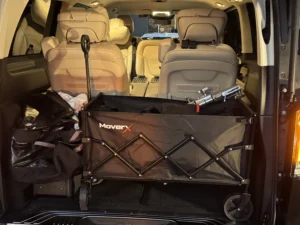
One of MCR EXEC’s production photographs shows equipment bags and a wheeled trolley in the rear of a Mercedes V-Class, behind the passenger seats. It is an example of equipment accommodated on a production booking.
The useful detail is the relationship between the luggage area and the seating layout. The photograph does not establish the weight of the items, the passenger count for that journey or the dimensions of another team’s cases. Use it to explain your requirements rather than assuming an identical fit.
Check V-Class equipment capacity alongside the passengers
The V-Class is the most popular vehicle among MCR EXEC’s production clients. For a particular booking, the question is whether the required seats and the complete load can be accommodated together.
Send the maximum number of people travelling at any point in the day. Include the director, representative or additional crew member joining later, as well as their luggage.
Then describe everything travelling with that group. A camera case, a long tripod bag and several soft bags create a different requirement from the same number of small suitcases. The quantity alone is not enough to assess the load.
Send photographs and measurements of the packed items
A photograph of the whole load helps show the combination of items. Measurements give us information that perspective can hide. Measure each item in its travelling condition, including its case, wheels, handles or other parts that project.
| Information | What to provide |
|---|---|
| Passenger count | The highest number travelling together on any leg. |
| Item list | Number of cases, bags, trolleys and other items. |
| External size | Length, width and height of each bulky packed item. |
| Weight | Weight of individual heavy items and the overall load where known. |
| Orientation | Anything that must remain upright or cannot be stacked. |
| Access | Items needed at intermediate stops and who needs to retrieve them. |
| Changes during the day | Additional passengers or equipment joining after the first collection. |
If an item is not yet packed or its dimensions are unknown, say so. A vehicle recommendation based on an incomplete list needs reviewing when the final load is available.
Confirm the standard or customised V-Class layout
MCR EXEC offers standard and customised Mercedes V-Class options. A customised interior can reduce luggage capacity, so an interior upgrade should be checked against the equipment requirement.
Ask us to assess the proposed vehicle against the full brief before relying on it for the shoot. Do not assume that seats can be removed, repositioned or left unused to create cargo space unless that arrangement has been discussed and confirmed.
Where the brief cannot be accommodated in the proposed vehicle, discuss another allocation. Multi-vehicle requirements can be reviewed against the passenger groups, schedule and availability.
Space is only one part of a suitable load
Equipment also needs an appropriate loading arrangement. The Highway Code’s vehicle loading guidance addresses overloading and securing loads, including heavy or sharp objects. A photograph showing items inside a vehicle is not, by itself, confirmation that another load is suitable to travel.
Flag heavy, fragile or unusually shaped items before booking. Explain any handling requirements and agree responsibilities rather than assuming specialist equipment handling forms part of the chauffeur service.
If the brief includes wardrobe items, props or equipment needing dedicated storage or handling, describe those requirements explicitly so the service scope can be established.
Will equipment stay onboard between filming stops?
If cases remain in a retained vehicle while the team films, explain whether they need to be accessible during that period. A bag needed at every stop has a different access requirement from luggage staying onboard until the final hotel return.
Agree where the vehicle will wait, who can retrieve the equipment and whether the chauffeur needs to remain with it. Raise any specific responsibility or insurance requirements before confirmation.
Our production site-manager chauffeur checklist covers those standby and access arrangements. If the vehicle also leaves on passenger journeys, use our film crew transport planning guide to check its availability.
Send the largest load expected during the booking
Prepare one passenger-and-equipment list for each proposed vehicle. If the load changes across several filming days, show the differences rather than sending only the first day’s requirement.
Include photographs, packed dimensions, known weights and anything that needs special positioning or access. Mark details still awaiting confirmation.
Use our production transport service page to discuss V-Class suitability and request a quotation for executive chauffeur support around your production schedule.


