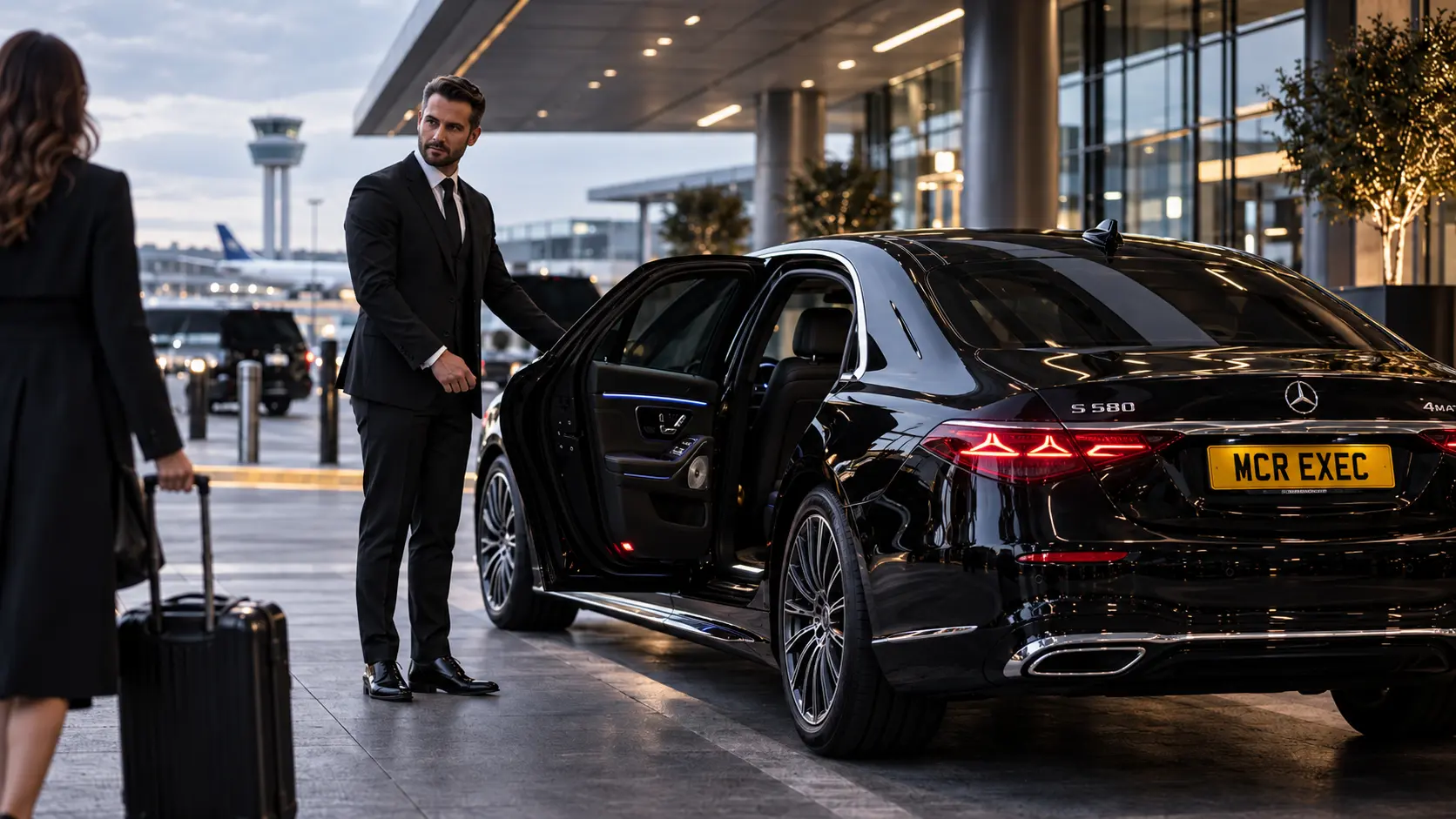
 A premium vehicle is only one part of executive hire. Professional chauffeur work also depends on presentation, communication, discretion and service standards.
More private-hire drivers are looking at premium electric vehicles and asking a natural question: can this be the route from Uber to chauffeur work? Making the transition from Uber to chauffeur work is an appealing next step for drivers seeking higher standards and luxury clients.
It is easy to understand why. A better vehicle, better clients, better hours and higher-value work will appeal to almost any serious private-hire driver. With premium EVs such as the BMW i5, Mercedes EQE and similar executive vehicles becoming more visible through platform, rental and rent-to-buy channels, the idea of moving into executive hire feels more achievable than it once did.
But there is a crucial point many drivers miss.
A premium vehicle may qualify for an app category. It does not automatically qualify the driver for professional chauffeur work.
At MCR EXEC, we have seen more private-hire drivers contact us while exploring the move into executive chauffeur work. Some already have a premium vehicle. Some are considering taking one on. Some are looking at rent-to-buy or weekly rental routes. The ambition is understandable, but the decision needs careful thought.
This guide explains what private-hire drivers should understand before taking on a premium EV for executive hire.
Why Uber drivers are looking at premium EVs
Platform standards are changing. Uber has updated its UK vehicle eligibility rules for Comfort, Exec and Lux, with new requirements applying to newly added vehicles from 1 August 2026 in London and from 19 October 2026 across the rest of the UK.
At the same time, rental and rent-to-buy schemes are making premium electric vehicles more accessible to private-hire drivers than they were previously. Hertz’s PCO Rent2Buy material, for example, is aimed at drivers who want access to PCO-ready vehicles through weekly payments and a route to ownership.
For a driver currently working through Uber or another app-based platform, this creates a tempting thought:
If I am already doing private hire, and I can now access a premium EV, can I move into chauffeur work?
The answer is: possibly. But the vehicle is only the beginning.
A premium car is not the same as a chauffeur service
An executive vehicle can open the door to better opportunities, but professional chauffeur work is judged by a much higher standard than the badge on the bonnet.
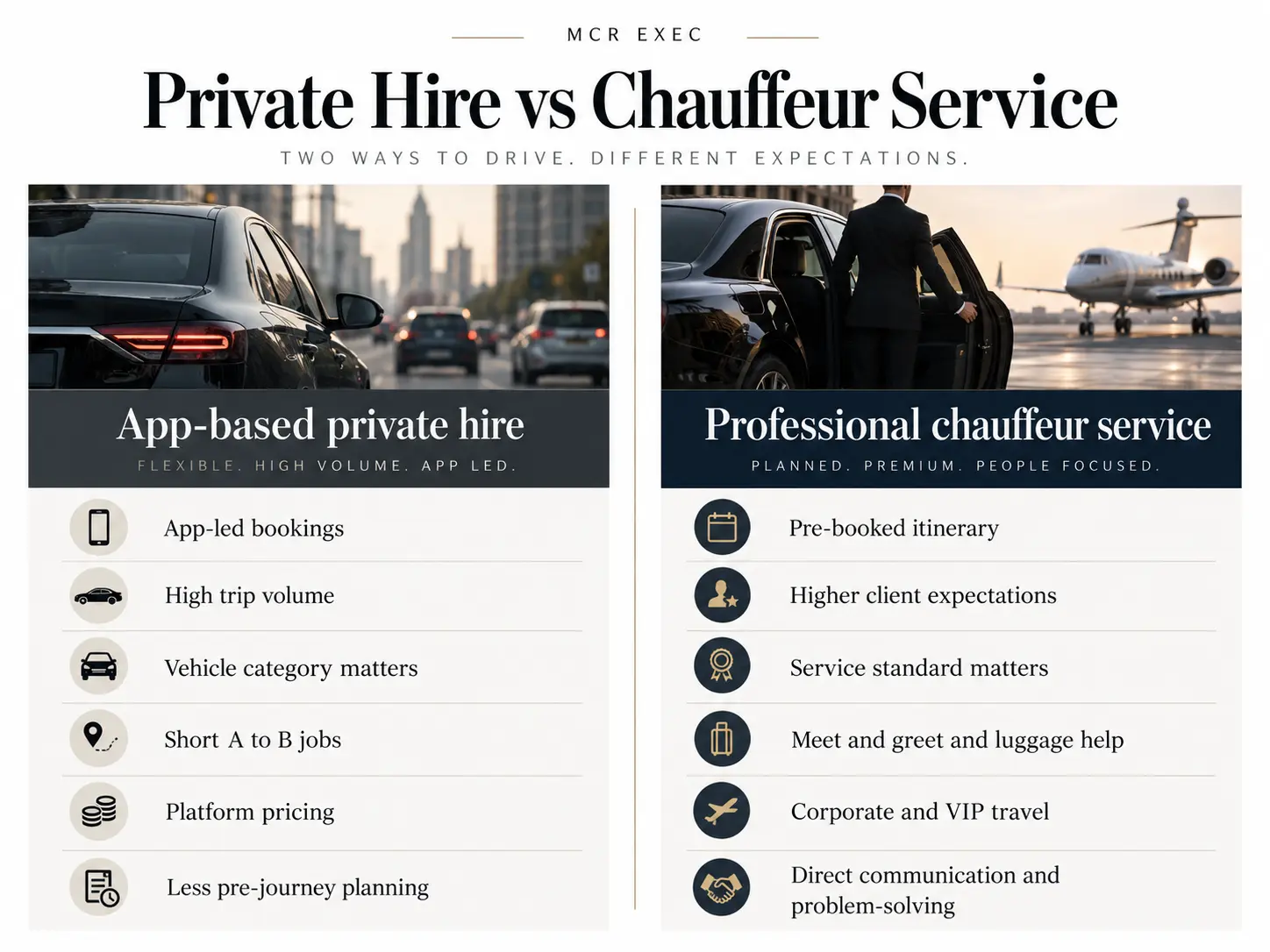
In standard private hire, the passenger often books a journey and expects to get from A to B safely and efficiently. In chauffeur work, the passenger expects more than that. They expect preparation, discretion, presentation, communication and calm management of the journey.
That difference is most obvious on airport, corporate and event bookings. A passenger using a professional Manchester Airport chauffeur service, for example, is not simply booking a car. They may need meet and greet, luggage assistance, correct timing, flight awareness and a chauffeur who understands how to manage the airport collection properly.
A chauffeur may be expected to:
- monitor the journey and understand the itinerary before arrival;
- meet the passenger correctly at an airport, hotel or venue;
- assist with luggage without being asked;
- understand when to speak and when to give privacy;
- communicate professionally with a booker, passenger or executive assistant;
- manage delays, traffic or venue access issues without panic;
- represent the operator’s brand, not just themselves;
- maintain the vehicle to a consistently high standard.
This is why a premium EV alone is not enough.
Uber can define a vehicle category. A chauffeur operator has to define a service standard.
The habits private-hire drivers may need to unlearn
Many private-hire drivers are good drivers. Many are punctual, hardworking and experienced. But app-based private hire can create habits that do not always transfer cleanly into chauffeur work.
App work is usually high volume, fast moving and platform-led. The driver receives a job, collects the passenger, completes the journey and moves on to the next one. There may be limited pre-journey planning and very little relationship with the client beyond that individual trip.
Chauffeur work is different.
A chauffeur is often dealing with a pre-booked itinerary, a named client, a corporate account, a VIP passenger or a family relying on a properly managed journey. The job may involve waiting, meet and greet, multiple stops, luggage, itinerary changes or communication with someone other than the passenger.
That requires a different mindset.
For drivers moving from app-based work, the biggest adjustments often include:
- not rushing the passenger;
- not showing frustration when plans change;
- not relying only on the sat nav;
- not being overly familiar with clients;
- not treating luggage help as optional;
- not assuming conversation is always welcome;
- not treating the vehicle as the only thing that matters.
Professional chauffeur work is not rocket science, but it does require awareness, judgement and emotional control.
Chauffeur work requires calm problem-solving
The passenger should feel calm because the chauffeur is calm.
That sounds simple, but it is one of the biggest differences between ordinary private hire and executive chauffeur work. Things go wrong. Flights are delayed. Bags are slow to arrive. Venue access changes. A meeting overruns. A client cannot immediately find the chauffeur in arrivals. A planned route becomes blocked. A corporate booker changes the itinerary mid-service.
The chauffeur’s job is not to panic, complain or make the passenger feel the pressure.
The chauffeur’s job is to find the next best solution.
That may mean adjusting the pickup point, communicating clearly with operations, reassuring the booker, planning a different route, checking airport parking arrangements or giving the client a realistic update without sounding flustered.
This is where the professional difference shows. Anyone can drive a nice car on an easy journey. Chauffeur standards are tested when the journey stops being easy.
Presentation, language and communication matter
A chauffeur is part driver, part host and part problem-solver.
Presentation matters because the passenger’s first impression is not formed when the car moves. It is formed when the passenger sees the chauffeur.
That includes:
- clean professional clothing;
- polished shoes;
- clean vehicle inside and out;
- correct greeting;
- appropriate tone of voice;
- clear but not excessive conversation;
- respect for privacy;
- polite language;
- awareness of the passenger’s mood and purpose of travel.
Some passengers want conversation. Some want silence. Some are preparing for a meeting. Some are tired after a long-haul flight. Some are travelling with family and luggage. Some are senior executives or VIP guests who expect discretion.
A good chauffeur reads the situation.
Knowing when not to talk is just as important as knowing what to say.
Licensing and plate exemption: the point many drivers miss
Executive chauffeur work is still part of the private-hire licensing world. That means drivers need to understand the difference between holding a driver licence, licensing a vehicle and operating bookings legally.
Many app-based drivers work under the umbrella of a platform or operator. The driver may have a private-hire driver licence and a licensed vehicle, but the platform provides the booking structure and operates under its own licensing model.
Executive hire can be different, particularly where plate exemptions are involved.
In many executive chauffeur settings, the vehicle must remain discreet. Overt identifying features such as external plates, council door stickers, large operator branding or taxi-style markings are often unsuitable for corporate and VIP work. Discretion is part of the product.
However, plate exemption is not simply a styling choice. It is a licensing matter.
Department for Transport best practice guidance recognises that executive hire and chauffeur services sit within private-hire licensing. It also states that licensing authorities should have effective arrangements to prevent plate-exempt vehicles being used for normal private-hire work.
Drivers must check the conditions attached by their own licensing authority. In many cases, a plate-exempt executive vehicle may not be permitted to carry out normal private-hire or app-based work in the same way as a standard plated PHV.
That creates a serious commercial decision.
If a driver takes a vehicle into executive plate-exempt work, they may reduce or lose the ability to continue standard app or local-base work with that vehicle. That can reduce the volume of fallback income available.
Before taking on a premium EV, drivers need to understand the licensing route properly. The question is not just:
Can I get the car?
The question is:
Can I legally and commercially use the car in the way I expect?
Why an operator licence changes the picture
There is another point many private-hire drivers underestimate.
Owning or leasing a premium vehicle is not the same as owning the customer.
Under Uber and similar platforms, the platform brings the passenger demand. The driver works within that structure. In executive chauffeur work, a driver who wants to take direct bookings and build a real chauffeur business needs to understand operator licensing.
Without the correct operator arrangements, the driver remains dependent on third parties for work. That could mean platforms, chauffeur companies, local operators or occasional subcontract opportunities.
There is nothing wrong with subcontracting for established operators. Many professional chauffeurs do exactly that. But it is important to be realistic.
Subcontract work is not the same as app work. It may not be constant. It may be seasonal and it may depend on standards, relationships, availability, geography, vehicle type, insurance, licensing and client fit.
For drivers who want to be masters of their own destiny, an operator licence and a direct client base may be necessary. That takes time, compliance, marketing, reputation and financial discipline.
Taking on the car is the easy part. Building the work is the harder part.
The financial reality of premium EV executive work
A premium EV may look like a route into better earnings, but the numbers need to be tested properly.
Drivers should factor in:
- weekly rental or finance payments;
- deposit or upfront cost;
- insurance;
- charging time and charging cost;
- tyres and brakes;
- valeting and presentation;
- airport parking and waiting;
- dead mileage;
- licensing costs;
- vehicle downtime;
- quiet periods;
- platform commission or operator margin;
- the risk of relying on third parties for work.
Drivers moving into executive hire often imagine better rates. That can be true for the right work, especially direct corporate accounts, airport transfers, VIP movements, events and long-distance chauffeur journeys.
But the work does not automatically appear because the vehicle is expensive.
If a driver enters the market expecting Uber-style job volume with chauffeur-level pricing, they may be disappointed.
Platform work is not the same as building a chauffeur business
Uber’s agreed acquisition of Blacklane shows that large platforms are taking premium and chauffeur-style transport seriously. That does not mean every driver with a premium car will automatically benefit.
Platform-led executive work can be useful, but it is still platform-led. The platform controls customer acquisition, pricing structure, allocation and terms. That is very different from building a chauffeur business with direct corporate clients, private clients, hotel relationships or operator partnerships.
At MCR EXEC, our view is simple: platforms may help some drivers fill gaps, but they should not be mistaken for a guaranteed executive-hire business model.
We have also observed that some chauffeur-platform rates appear far more compressed than they were a couple of years ago. Whether that is due to increased supply, platform strategy, wider competition or changing market conditions, the lesson is the same.
Do not take on a premium vehicle unless you understand where the work will actually come from.
Who is suited to the move from Uber to chauffeur work?
The move can make sense for the right driver.
Good candidates are often drivers who:
- are already punctual and reliable;
- take pride in their vehicle;
- understand customer service;
- communicate clearly;
- stay calm under pressure;
- dress and present themselves professionally;
- understand discretion;
- are willing to follow operator instructions;
- accept that waiting can be part of the job;
- want to build long-term professional relationships.
The move may be risky for drivers who:
- are purely chasing higher fares;
- do not like waiting;
- struggle with communication;
- become frustrated when plans change;
- do not understand licensing restrictions;
- expect regular app-style volume;
- take on a vehicle before understanding the market;
- rely entirely on third parties to fill the diary.
Executive hire can be rewarding, but it is not automatic. The drivers who succeed are usually those who understand that chauffeur work is a standard, not just a vehicle category.
Final advice before taking on a premium EV
If you are a private-hire or Uber driver considering a move into chauffeur work, ask yourself these questions before committing to a premium EV:
- Do I understand my licensing authority’s rules on executive hire and plate exemption?
- Can I still do normal private-hire work if the vehicle becomes plate exempt?
- Do I need my own operator licence to take direct bookings?
- Where will the work actually come from?
- Can I afford the vehicle during quiet periods?
- Am I comfortable with meet and greet, luggage help, waiting and corporate expectations?
- Can I communicate calmly with passengers, bookers and operators?
- Am I building a chauffeur business or simply taking on a more expensive car?
A premium EV can be a sensible step for the right driver. It can raise standards, improve presentation and open the door to better-quality opportunities.
But the vehicle alone is not the business.
A premium EV can help you enter the executive market. Your service standard determines whether you belong there.
FAQs for private-hire drivers considering chauffeur work
Can an Uber driver become a chauffeur?
Yes, but becoming a chauffeur requires more than holding a private-hire licence and driving a premium vehicle. Drivers need to understand service standards, licensing conditions, presentation, communication, luggage assistance, meet and greet and the expectations of corporate and executive clients.
Does a BMW i5 or Mercedes EQE make a driver suitable for executive hire?
No. A premium EV may help a driver meet certain vehicle standards, but chauffeur work depends on the complete service. The vehicle, driver conduct, licensing position, communication and reliability all matter.
Can a plate-exempt executive vehicle still be used for normal private hire?
This depends on the conditions set by the relevant licensing authority. Drivers should check their local council’s rules before assuming they can move between executive hire and standard app-based private hire with the same vehicle.
Do private-hire drivers need an operator licence for chauffeur work?
If a driver wants to take direct bookings, they need to understand private-hire operator licensing. Many app-based drivers work under a platform or operator structure, but building an independent chauffeur business may require proper operator arrangements.
Is moving from Uber to chauffeur work a good idea?
It can be a good move for the right driver, but it is not automatic. Drivers should understand the financial commitment, licensing rules, source of work and service expectations before taking on a premium vehicle.
Working with MCR EXEC
MCR EXEC works with selected licensed chauffeurs and executive vehicle partners across Manchester, Cheshire, Liverpool and the wider UK.
We are interested in professional drivers who understand that chauffeur work requires more than a suitable vehicle. Licensing, presentation, communication, discretion and reliability all matter.
If you are a properly licensed driver with a suitable executive vehicle and you are serious about professional chauffeur work, you can contact MCR EXEC with your licensing details, vehicle information, operating area and relevant experience.
MCR EXEC provides executive airport transfers, corporate chauffeur travel, event transport, long-distance chauffeur hire and premium group travel across Manchester Airport, Greater Manchester, Cheshire, Liverpool and the wider UK.
To learn more about the company’s vehicles, visit the MCR EXEC chauffeur fleet. For airport clients, see our Manchester Airport chauffeur service. For longer journeys, see our long-distance chauffeur service.